Choosing the Right Challenge Coin Size
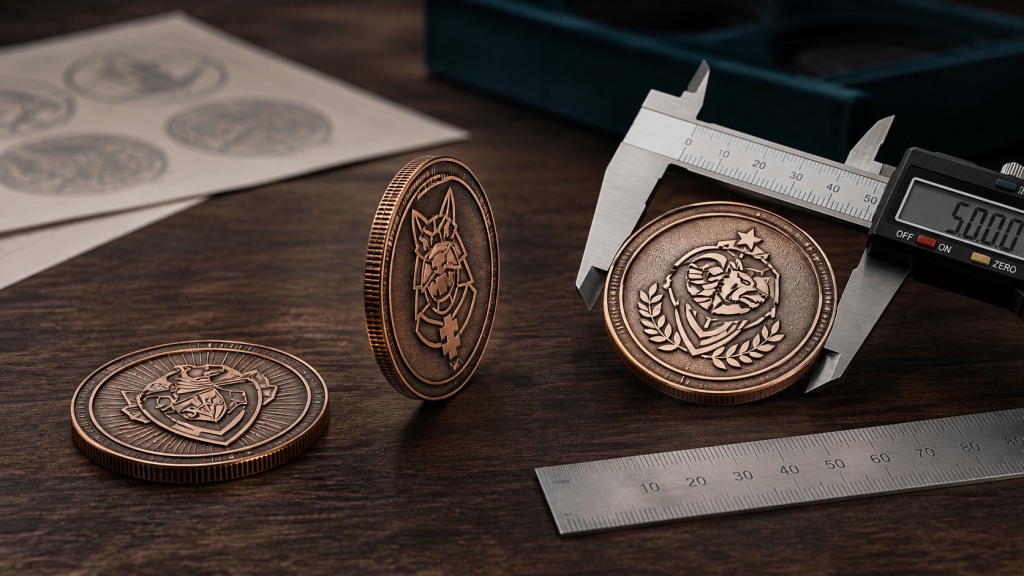
Challenge coin size controls more than appearance. Diameter changes how much artwork can be reproduced, how readable the text will be, how the coin feels in a hand and which packaging will fit. Thickness affects weight, edge visibility and the amount of relief that can be created. Both dimensions should be selected before final artwork is approved.
Quick answer: 1.75 inches (44.45 mm) is a versatile starting diameter for many custom challenge coins. A 3 mm thickness suits a practical carry coin, while 4 mm provides a more substantial feel and more room for edge detail. Large display coins may be 2 inches or more, but size should serve the design rather than compensate for crowded artwork.
The custom challenge coin collection shows how different formats use relief, plating and color. Treat those finishes as part of one specification with diameter and thickness.
Common Challenge Coin Diameters
| Diameter | Metric size | Typical use | Design guidance |
|---|---|---|---|
| 1.5 in | 38.1 mm | Compact carry coin or simple emblem | Keep text short and borders bold |
| 1.75 in | 44.45 mm | General military, club and corporate coin | Balanced room for logo, text and color |
| 2 in | 50.8 mm | Commemorative or presentation coin | Supports more detail and visual hierarchy |
| 2.25 in | 57.15 mm | Display-oriented and premium designs | Plan weight, stand and packaging early |
| 2.5 in and above | 63.5 mm and above | Desk display, award or limited edition | May need a stand, capsule or custom box |
A measurement on a screen can be deceptive. Print the coin outline at 100 percent scale, cut it out and hold it. Place the smallest text at final size. This simple test often reveals that a design needs fewer words rather than a larger diameter.
How Thickness Changes the Coin
Thickness is usually specified in millimeters. A 3 mm coin feels familiar and portable. A 4 mm coin has more visual presence and a wider edge. Five millimeters and above can create a premium display object, but weight and shipping increase quickly.
| Thickness | Feel | Best suited to | Points to check |
|---|---|---|---|
| 2.5-3 mm | Practical and easy to carry | Standard issue and larger quantities | Keep relief and edge work appropriate |
| 3.5-4 mm | Substantial premium feel | Commemorative and presentation coins | Confirm total weight and package fit |
| 5 mm or more | Heavy display piece | Desk awards and limited editions | Plan a stand, case and freight allowance |
Do not assume that a thicker coin automatically creates better 3D relief. Relief depth is engineered into the front and back artwork. Extremely deep features, thin walls and opposing high points can affect manufacturability. Share the intended effect and let the production drawing establish safe depths.
Size, Detail and Readability
Start with the viewing distance
A carry coin is examined at close range, while a display coin may be viewed from farther away. Strong silhouettes, clear borders and a single focal emblem remain effective at either distance. Tiny sentences, dates and mottos should be tested at actual scale.
Separate essential from optional information
Place the organization name, central emblem and primary message first. Move secondary details to the reverse or edge. If every idea is treated as equally important, increasing the diameter will not fix the visual hierarchy.
Use 2D and 3D relief deliberately
Two-dimensional levels work well for logos, symbols and enamel divisions. Gradual 3D relief is useful for portraits, sculpted objects and organic surfaces. The broader challenge coin design guide explains how artwork decisions move into production.
Diameter and Thickness Affect Cost
Larger and thicker coins consume more metal and add weight to every carton. Tooling, color, plating, edge work, packaging and quantity also affect the total. Compare delivered totals using an identical specification. A low unit price for a thinner coin is not directly comparable with a heavier presentation coin.
Tooling is mainly a fixed project cost. For a clear view of what is included, read the guide to challenge coin mold fees and cost drivers. Ask for price breaks at realistic quantities and calculate the landed cost per usable coin.
Choosing a Size for Common Uses
- Everyday carry: prioritize comfortable diameter, rounded edges and manageable weight.
- Military or service presentation: allow enough space for unit identity, date and a meaningful reverse.
- Corporate recognition: balance a clean brand mark with a concise achievement message.
- Fundraising: choose a size that looks valuable without making packaging and postage inefficient.
- Desk display: larger diameters and thicknesses can work well when supplied with a stable stand.
- Numbered limited edition: reserve a readable area for numbering and document the final quantity.
Edge, Packaging and Display Considerations
A thicker edge can carry text, reeding, rope patterns or other treatments. Edge details need enough width and should be shown on the proof. For larger coins, ask whether an acrylic capsule, velvet pouch, fitted box or display stand is appropriate. Packaging must match the exact finished diameter and thickness, not a rough estimate.
Large or unusually thick coins can tip lightweight stands. Request a physical sample or confirmed stand specification when display is part of the program. If recipients will carry the coin, avoid unnecessary weight and sharp edge features.
Specification Checklist Before Requesting a Quote
- State diameter in both inches and millimeters.
- State finished thickness, not only relief depth.
- Identify one or two custom sides.
- Choose 2D, 3D or a combination for each area.
- List plating, enamel and printed details.
- Specify the edge treatment.
- Select a pouch, capsule, box or stand.
- Provide quantity, delivery location and required date.
Review other formats in the Difway Awards product collection and send the completed specification through the custom quote form. A production proof should show front, back, edge, diameter and thickness before tooling begins.
Frequently Asked Questions
What is the standard challenge coin size?
There is no universal requirement, but 1.75 inches is a common and versatile diameter. The correct size depends on artwork, carrying comfort and presentation.
Is a 2-inch challenge coin too large?
No. Two inches works well for commemorative designs that need more detail. It is less convenient for everyday pocket carry, so confirm the intended use.
What challenge coin thickness feels premium?
Many buyers consider 4 mm substantial without becoming excessive. Perceived quality also depends on relief, finish, edge quality and presentation.
Does a thicker coin allow deeper 3D detail?
It can provide more design flexibility, but safe relief depth depends on the complete front and back structure. The supplier should engineer the relief from approved artwork.
Should large coins include a stand?
If the coin is intended for a desk or shelf, a fitted stand improves presentation. Confirm stability using the final diameter, thickness and weight.